Campsite selection can make or ruin the great experience of your camping trip. Probably, anyone who has camped often picked the undesirable location. While there are ideal ways to plan a camping trip, as posted in OurBlogPost, it is crucial to include some key considerations in your planning. To help you avoid a few of the common mistakes in camping trips, we have put together some of the things you need to consider when selecting a campsite.
Location Amenities
When searching for a site, consider your must-have and potential needs. Since it could be a personal decision, among the suggestions are:
- Water source. If you need water to drink, how much will you be able to walk with? Will you need it for your travels?
- Toilets. How far away are they from you? Do you need them to be close and possibly get some of the odors and foot traffic to them, or are you self-sufficient and not requiring easy access?
- Privacy. What screening is there between you and the following site? Will you be able to hear and see every part of a neighborhood campground?
- The proximity of various sites: how close is the nearest site? Are you all going to be squashed together?
Think about the noise variable when you slip into a tight spot for a swim. If you choose a site near another group of campers, are you giving them the privacy you expect, or would you camp farther away?
Size
 Campsites will vary proportionately, and you need to take into account the size of the grounds. Did you get a large tent? Exactly how many tents would you need to fit in a space? Will your trailer/camper fit, and can you stand in a spot where you can open up without obstructing others? Can you maneuver the trailer around the field?
If you pay for one site, you can’t move to another without paying for another. Another important consideration when choosing the camping area’s size is if you will use a campfire? You don’t need the fire to be near your equipment, especially the tent. You want the fire to be far away, so the smoke doesn’t travel through your shelter. Find a place where your gear will fit and where you can hold fire safely.
Level
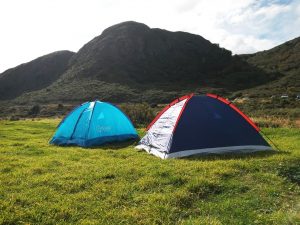 Sleeping on a mountain can cause you to slip off your mattress or cause blood to rush to your head, or maybe both. That’s why you need to find an area that is flat and comfortable for your shelter. Your legs do not need to be higher than your brain. A dull place to sleep may be impossible, so that a slight incline may be delicate, but sleep with your head near the top of the slope.
Another gear could be on a hill – a minimal angle, different. Your drinks will soon slip off the table, but nothing too extreme. A sloping site indicates that rain can accumulate, forming puddles and increasing the likelihood of water entering the tent.
Shade
Once the weather is likely to be warm, shade is a fantastic option to get. Look around for trees at the campsite, and see what sort of trees are growing near your desired area. Eucalyptus trees are notorious for losing their branches, especially after a period of warm weather followed by rain. For this reason, they are also referred to as “windowmakers.” Avoid camping under large poles or several trees that have large branches or are lifeless.
Trees that are healthy and alive can provide needed shade, but it’s also important to consider where they are placed on the campsite. You’ll want to position yourself where the tree will provide shade in the afternoon, so pay attention to where the sun rises and sets and place your camping equipment where it will gain shade during the day.
 You need to learn where you need to move. An unprepared and unplanned trip can be exciting, but not to get a film session. It is as we have to see that the place where we will have the acceptable requirement to acquire a movie session. Also, the place must be suitable for the theme of the movie you want to do. For this reason, you should Google the most amazing and suitable places.